SEO for Pet Care Businesses That Wins the Trust First
Pet owners hand over family members, not just animals. I make your business the obvious safe choice.
It starts at 11pm with a matted doodle
She is in bed, phone six inches from her face, scrolling grooming photos. The doodle is eight months old, matted behind the ears, and the breeder warned her that a bad first groom can traumatize a puppy. She is not looking for the cheapest option. She is looking for proof.
Across town, a man watches his dog lunge at another dog on the evening walk and types "reactive dog trainer near me" with a knot in his stomach. Somewhere else, a family with flights booked in ten days is trying to find someone they would trust with the house keys, the alarm code, and the anxious rescue who hides from strangers.
Three different searches, one identical feeling: I am about to hand a family member to a stranger, and I need to be sure. I do SEO for pet care businesses, so I see this daily: the businesses that understand that feeling get the bookings, and the ones that do not get scrolled past.
Nobody hires a pet care business. They audition a stranger.
Think about what a pet owner is actually buying. Not a haircut, not a walk, not a training session. They are buying the belief that a stranger will be gentle with the creature they love most, in their home or yours, while they are not watching. That is the highest trust bar in local services, and it changes everything about how your marketing should work.
It means your Google Business Profile is not a listing, it is an audition tape. Your reviews are not stars, they are character references. Your photos are not decoration, they are evidence. And your website has exactly one job: answer every fear before the first message is ever sent. In the USA, the UK, and Australia, owners audition the same way: photos first, reviews second, booking third.
The five corners of pet care each audition differently. Here is the map.
| Business | What the owner is really asking |
|---|---|
| Dog groomers | Will you be gentle with my dog, and can you prove it with photos? |
| Dog trainers | Can you fix what is making our life miserable, and what are your methods? |
| Dog walkers | Can I trust you with my keys and my dog, every single day? |
| Pet sitters | Who are you, really, and will my home be safe? |
| Pet boarding | Will my dog be happy here for a week, not just supervised? |
The groomer gets judged by photos at midnight
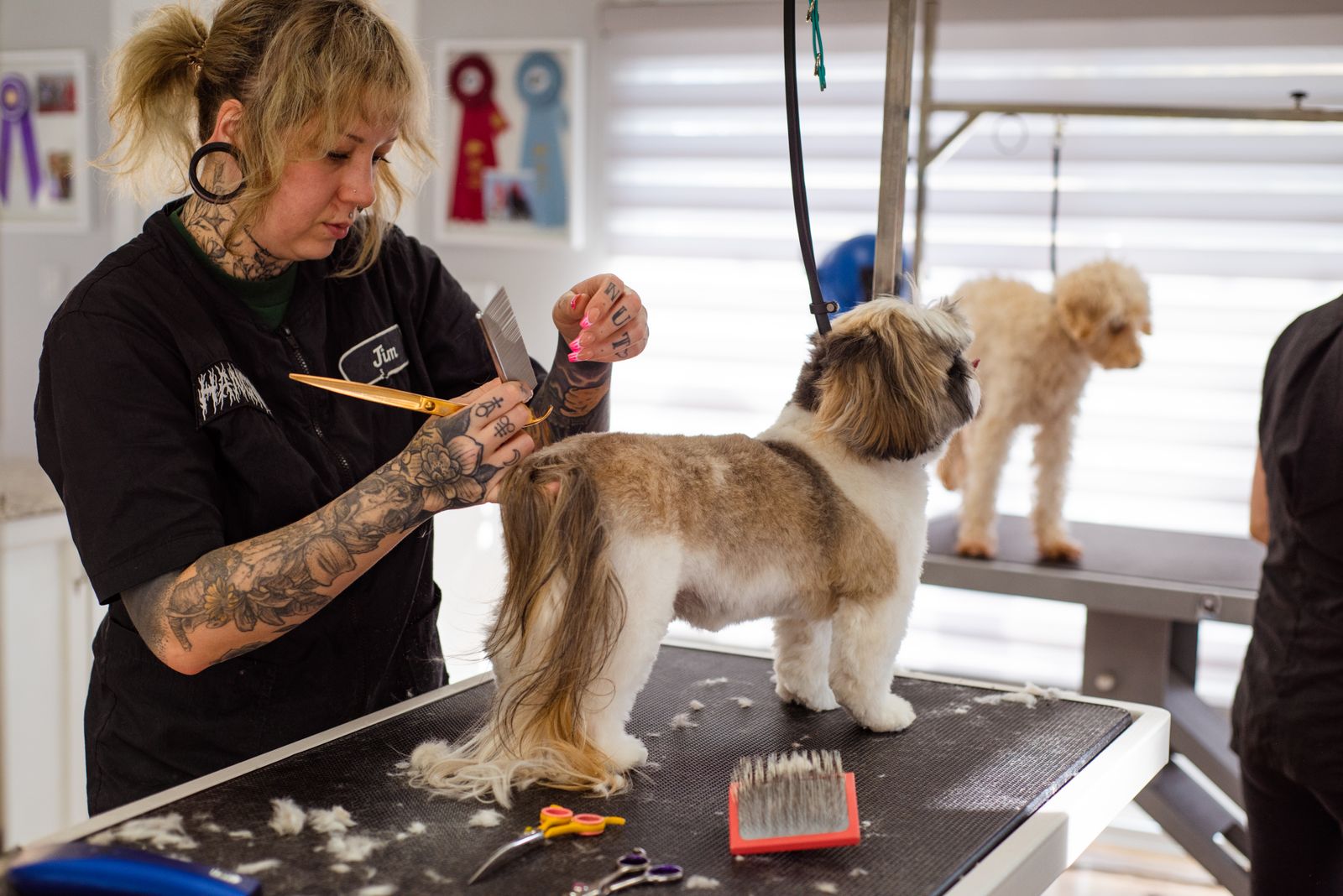
That 11pm scroller from the story? She searches "dog groomer near me" or "doodle groomer" plus her town, then judges in seconds. Do the photos show happy dogs and clean cuts? Do the reviews mention gentle handling? Can she book without calling? The groomer who answers yes to all three gets the appointment. Everyone else gets scrolled past.
The unlock most groomers miss is breed specific search. Doodle owners worry about matting and style, senior owners about gentle handling, puppy owners about first groom specialists. Dedicated pages for each capture these high intent searches while competitors fight over the generic term. And grooming is recurring revenue in disguise: a happy client returns every six to eight weeks for years.
- Your own before and afters, not stock. Real phone photos beat polished stock every time.
- Breed specific pages. Doodle owners, seniors, anxious dogs, and puppies each search differently.
- Online booking and starting prices. "Call for pricing" reads as expensive to a first timer.
- A review text after every pickup, when relief is fresh.
The trainer is selling belief, not sessions
A dog trainer is not selling sessions. They are selling the belief that a stranger can fix the thing making family life miserable: the lunging at other dogs, the destroyed couch, the puppy that bites the kids. Your customers arrive anxious and skeptical, with strong opinions about training methods, and they interrogate everything: your philosophy, your credentials, your proof.
Method transparency is your biggest conversion lever. Owners with a reactive or anxious dog have usually already decided what kind of training they want, and vagueness loses them to the trainer who states their methods proudly. Then the proof library: problem specific pages, short video clips of real sessions, and honest timelines and pricing. Group classes, private sessions, and board and train get separate conversion paths, because their buyers are not the same people.
- State your methods proudly. Vagueness loses researchers to the trainer who says it plainly.
- Problem pages, not service pages. Owners search their exact problem, so each one gets a page.
- Video proof everywhere. Nothing sells training like watching a reactive dog walk calmly past another dog.
- Vet and groomer partnerships. In the pet world, a vet recommendation link is worth ten directory listings.
The walker should stop renting clients from the apps
Right now, somewhere in your city, an owner is booking walks through an app that takes a cut of every walk the walker earns, and the walker has no say in any of it. The apps solved discovery for dog walking and then taxed it. My entire strategy for walkers is built on one idea: your own website should be your best client source, not a profile buried on someone else's platform. Owners searching "dog walker near me" are happy to book direct. They just need to find you first.
Walking is the most hyperlocal business in pet care, so your SEO can be ruthlessly focused: genuine neighborhood pages with the parks and routes you actually walk, a Google Business Profile that looks alive with daily photos, and your GPS walk updates showcased as the feature that converts app users to direct clients. The apps make every walker look identical; your own site shows your real routes, your regular dogs, your rain or shine reliability. Every new client in an existing neighborhood makes the whole route more profitable. For a walking business, SEO is route building.
- Own five neighborhoods completely. You do not need to rank citywide. Deep local relevance in a tight radius wins.
- Sell the recurring walk. Daily walks and puppy visits as separate offerings. The subscription is the business model.
- Key handover content. Vetting, insurance, and your meet and greet process, answering the biggest fear head on.
- Look like a person, not a profile. Real routes, real dogs, real reviews. The local with a face beats the platform stranger.
The sitter is asking for house keys
The flights are booked, the suitcases are out, and now comes the hard part: finding someone to be trusted with the house keys, the alarm code, and the anxious rescue who hides when strangers come in. Pet sitting is not a convenience purchase. It is a trust transaction disguised as a service booking. Owners searching "pet sitter near me" are not comparing prices first. They are interrogating character.
The searches reveal the anxiety directly: trusted pet sitter near me, in home pet sitting, what to ask a pet sitter before booking. The sitter whose site addresses the fear head on wins. That starts with leading with the person: your about page is your most important page, with your real face, your background, and why you do this work. Then trust pages for every fear: insurance and credentials, the meet and greet process, a visit walkthrough, emergency protocols. Specifics like medication routines and update frequency are what get quoted in reviews. And own the holiday calendar: Christmas and summer spikes reward sitters who published seasonal content months ahead.
- Show your face. A real face, story, and your own pets beat an anonymous brand page.
- State insurance and background checks upfront. Careful owners look for these first. Buried credentials read as missing credentials.
- Make the meet and greet a page. How it works and that it is free removes the final objection.
- Get specific. Medication, updates, visit structure, emergencies. Specifics close bookings and get quoted in reviews.
The boarder wins Christmas in July
Boarding runs on a calendar of panic: the week before Christmas, the first school holiday of summer, the long weekend everyone books at once. Owners who planned ahead got their spot in October. Everyone else is frantically searching "dog boarding near me" with three days notice. I treat your year as two different campaigns. Peak season is about capturing overflow: ranking for urgent boarding searches, showing availability clearly, and converting the panicked searcher who will pay premium rates for a spot. Off season is about building the asset: the content, the reviews, and the authority that decide who wins when the next peak hits.
Boarding is the most considered purchase in pet care. Owners need to believe their dog will be happy for days, not just supervised, so your site must sell the facility before the visit: virtual tours, webcams, staff introductions, play schedules, reviews describing dogs dragging owners toward your door. Show nightly rates by dog size with add ons listed, because hidden pricing reads as expensive. And make every page drive toward booking a tour, which closes far better than a phone quote.
- Peak season pages, published early. Holiday and summer pages go live months before demand.
- The facility is the content. Galleries of suites, play yards, and staff in action, updated seasonally. Your highest converting asset.
- Transparent pricing pages. Nightly rates, add ons, holiday rates, all crawlable. Captures cost searches and pre qualifies callers.
- Reviews tied to pickup. Happy pickup is peak emotion, and a simple text then captures it.
Here is what the work actually looks like
Week one is an audit of everything: your site, your Google profile, your reviews, and the competitors outranking you. I find the trust gaps first, because in pet care those are the revenue gaps. Then we fix in priority order. Your profile gets rebuilt with the right categories, services, and photos. Your review flow gets set up so every happy pickup, groom, or walk turns into ranking fuel. Your pages get rebuilt around the searches your customers actually type, with the proof placed exactly where doubt appears.
Every month you get a plain English report: what changed, what it did, and what is next. No jargon, no vanity charts. And because this is a one person studio, you work directly with me from the first call to the monthly review. If you run a grooming salon, a training business, a walking route, a sitting service, or a boarding facility, the playbook adapts to your corner of pet care, but the principle never changes: earn the trust first, and the bookings follow. Strip away the jargon and that is what SEO for pet care businesses really comes down to.
Pet care questions, answered.
Ready to dominate pet care businesses?
Book a free 30-minute strategy call. I'll audit your current visibility live and tell you exactly what it would take to reach the top 3.